

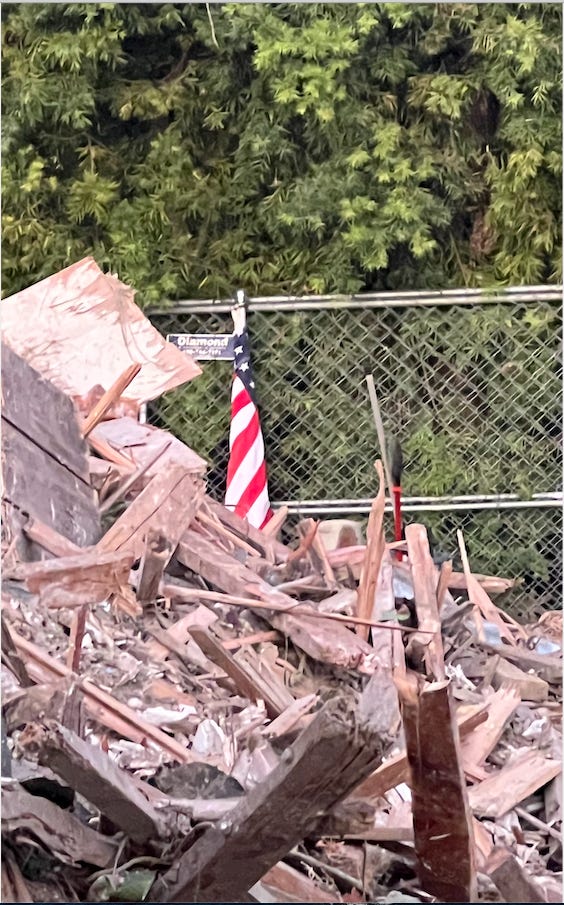
They told me he had an arsenal of firearms in the house, and he’d taken to drinking heavily since his wife left. I’d heard the scatter cracks and singular booms, deep into the night, from halfway up the block. Some were clearly fireworks — some were clearly not.
About a decade ago, when we moved into the neighborhood, we’d take long walks to get the lay of the land, to meet the locals. My husband had grown up in a small Pacific Northwestern town, but I’d grown up in a typical Los Angeles situation, where you didn’t know your neighbors beyond a head nod between driveways. Now here we were on these circuits of sidewalk, under green, lollipop-topped trees, dodging pods of children on scooters, with Labradors trailing. It seemed, to me, to be a joke on the American dream — idyllic overkill, but lovely.
One of the first people we met was “Dan,” the man who lived with his family at the end of our block. Dan worked in construction, he was pleasant, always with a smile. He and my father had a good chat once, a conversation with a conspicuously manly posture. My father in his Air Force cap, Dan in a flannel, they talked about the military, airplanes, WWII technology, man stuff.
For the uninitiated, the conversation would’ve looked like two buddies talking on the corner, but there was a legacy of historical weight between those silhouettes. An older Black man, and a middle-aged white man pausing for a chat in a mid-day suburban intersection — this is an American tinder box. One of them was more aware of this.
Dan didn’t know, but my dad was reading him for acceptance clues, which is a thing that Black people do with new white people they’ve just met. It’s not judgement, it’s assessment. My father’s stance was more grounded than Dan’s, my father listened more and said less, my father made agreement sounds, before making his own statements. My dad was 81 at the time, and having lived in Jim Crowe America until he was in his twenties, he retained certain social survival instincts. I don’t have all of those instincts, but I know them when I see them. Dad was cool, and the chat was pleasant, but he felt the need for a certain protective aura, and it would be years until I understood why.
Up through 2018, our relationship with Dan was polite, friendly, but growing sparse. He became more scarce. When I walked past his driveway, he would still nod, but his gaze was a furrow of suspicion. He grew out a beard which grayed and maned like a warning. Bumper stickers appeared on his car: “Trump,” various anti-Hillary swag, an OANN sticker, and right-wing radio stations.
Through 2019, I hardly saw Dan at all, unless he was in his garage working on something. His body widened, his beard took over his neck, and other men began coming to his house to stand around in the driveway and talk at close range. Neighbors told me, around this time, his wife and kids left.
Before the 2020 election, Dan installed enormous floodlights on the front of his house, facing outwards, directly into the windows of the new family across the street. He also installed an American flag, atop a thick, metal flagpole, must’ve been 30 feet high. The day after Biden won, he turned the flag upside down.
The following Fourth of July, 2021, I was upstairs at the sink, washing up, when I heard Ronald Reagan. For a moment I thought, “Am I being haunted?” But what would Ronnie want with me? I stuck my head out the window. The whole neighborhood boomed with “It’s morning in America,” the presidential ad from 1984. The Reagan and Mondale spell, weaving, in soft-focus tones, above a pastel musical sweep of strings and clarinet. The entire block shuddered with early 80s mortgage rates, small business loans, and a behemoth cotton white bride in a white walled church, clapped on by weeping old folks, under a billowing flag. A seismic boom of Americana. A delusion to shatter glass. I texted some of my neighbors who lived closer to the corner, and they confirmed it was coming from Dan’s house. He finally turned it off around 10:30pm, followed by fireworks and some other sounds.
In the year to follow, the front of his house gathered machine pieces, and a couple of broken cars. Neighbors said that when they saw him, he was rarely sober, and the explosions continued at night.
One evening we had a friend over, and he’d parked down at the end of the block, in front of Dan’s house. The next day he told us that he’d called his girlfriend from his car, and Dan, cloaked in the stealth of night, knocked on his window, making him jump. He threatened our friend, accused him of canvasing the street for home invasion. Our friend, not wanting trouble, drove away. But that wasn’t the end. Dan followed him in his car. He followed him back to Pasadena (which is just under an hour away), on the highway, off the highway, through his neighborhood, until our friend had the presence of mind to drive to a police station. Dan peeled off and left him there.
We told all our friends to avoid the house from then on — told them to park on the other end of the block when visiting. I stopped walking the kids near the property. It felt like our individual lives were being infiltrated by the conspiratorial pathos of this man’s imagination, lit wild by the MAGA collective. Like the essence of the bumper stickers, the upside-down flag, the cracking bullet chambers, and the vehicles in disrepair, were encroaching on the entire block, like a rusting industrial fever dream.
We put up with it. We looked out for each other. Then one day, I noticed the piles of disaster began to disappear. The driveway seemed to widen. Word was, Dan was moving out. The cars began to go, then his truck with the bumper stickers, then we hardly saw him.
For two years the house sat — peeling, gathering shadows in the winter, bleaching in the summer. The stubby palms clawed ambitiously through what used to be a hedge. Junk mail sprawled flat, and pointless. Still, the carcass lingered at the corner of the block, like there was some ghost left. The anger and the lies which fueled the property for so long, idled in the doorway.
And in 2024 Trump ran again. It was impossible for this to happen again, look at all the madness in his wake. This era must be done, right? No. I woke up this morning feeling like 3/5 of a human. It’s not so much the insult, as the endlessness. The unfathomable cruelty of my own country.
I drove my daughter to school, trying to explain what happened in a way that was truthful, but not hopeless. I was attempting this as much for her, as for myself. I dropped her off and drove on alone. I was keenly aware of being a brown-skinned woman, momentary alone, in America. I felt like I was already under suspicion, meeting eyes with drivers through the windshield. Which of them might’ve used their precious vote to mark me as an unworthy thing, subject to the decisions of strange men.
Rounding the last turn onto my block, I saw several of my neighbors gathered at the corner house, and across the street. They had their phones out, filming. I looked left out the window. A huge yellow excavator had rolled up onto Dan’s old driveway. The arm was reaching out and coming down, teeth grinding into the plaster façade. Chasms and chasms of mechanical reach. Inverting the walls, crumbling it down. Finally, gravity began to take the roof.
As I passed the place, I felt the end of an era. The threat of Dan had seemed a permanent feature, one that we all simply had to weather. Yet year by year, before our eyes, engulfed in his demons and suspicions, he devoured himself. And now, on the first day after what seems to be another coming chapter of horror, I witnessed the demolition of the house of Dan.
All houses come down.
Cycles cycle out.
Watch.
Sometimes it’s the beginning of the end.